

It happens incredibly fast.
You wake up late.
Spill your coffee.
Get an irritating email.
Someone says something that bothers you.
Traffic is terrible.
You make a mistake.
A meeting goes poorly.
And suddenly you think:
“Today is going to be one of those days.”
Think about what just happened.
Maybe twenty bad minutes occurred.
But your mind just made a prediction about the next twelve hours.
And once you’ve decided you’re having a bad day, something interesting happens.
You begin collecting evidence.
Another inconvenience?
Of course.
Someone annoys you?
Figures.
Something doesn’t go your way?
See?
I knew today was going to be terrible.
One moment became a story.
The story became a mindset.
And the mindset started shaping the rest of the day.
A Bad Morning Isn’t a Bad Day
This sounds simple.
But it’s incredibly useful:
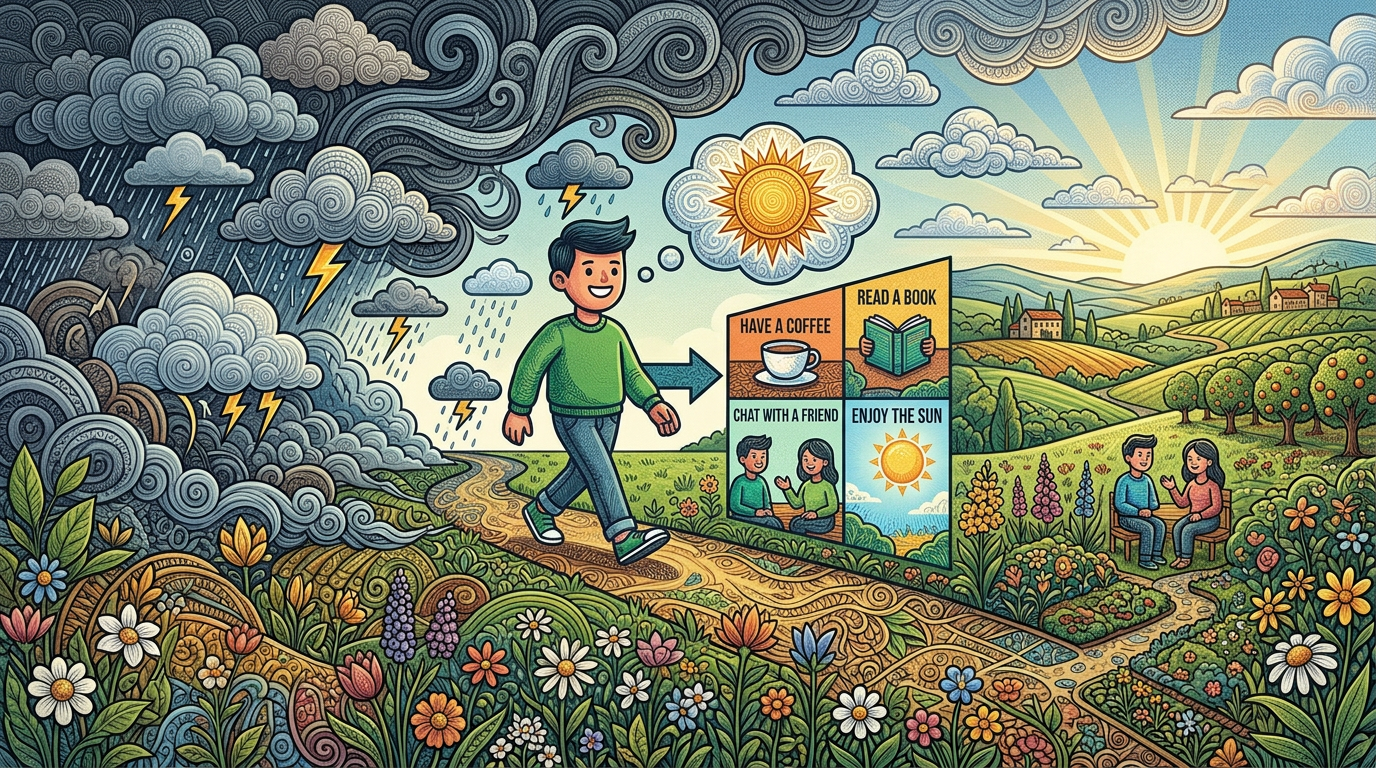
You are allowed to restart your day at 10:37 in the morning.
You don’t have to wait until tomorrow.
You don’t need Monday.
You don’t need next month.
You don’t need January 1.
You can simply decide:
That part of the day didn’t go well. The next part can be different.
We divide our lives into days because calendars require it.
Your mindset doesn’t have to.
Stop Giving One Moment So Much Authority
Someone says something rude.
Why should that person get the next six hours of your life?
Think about it.
The interaction lasted thirty seconds.
But you replay it:
Driving.
Eating lunch.
Working.
Showering.
Lying in bed.
Now someone who irritated you for thirty seconds has occupied hours of mental real estate.
They probably aren’t even thinking about it anymore.
You are.
Don’t give a temporary moment permanent access to your attention.
The Second Arrow
There’s an old idea sometimes described as being struck by two arrows.
The first arrow is what happened.
The second is what we do to ourselves afterward.
You made a mistake.
First arrow.
Then:
“I’m such an idiot.”
“I always do this.”
“Nothing ever works out for me.”
“Everyone probably thinks I’m incompetent.”
Second arrow.
Someone disappointed you.
First arrow.
Then you replay the conversation fifty times.
Second arrow.
Something unexpected costs money.
First arrow.
Then you spend the entire weekend worrying about every possible financial disaster.
Second arrow.
We can’t always control the first arrow.
But we often have far more influence over the second.
Don’t Turn Events Into Identities
There is a huge difference between:
“I failed at something.”
and:
“I’m a failure.”
Between:
“I handled that badly.”
and:
“I’m terrible at this.”
Between:
“My business is going through a difficult season.”
and:
“My business is doomed.”
Between:
“My relationship is struggling.”
and:
“Our relationship is broken.”
Language matters.
Because temporary circumstances can quietly become permanent identities if we repeat them long enough.
Describe what happened.
Don’t turn it into who you are.
Your Brain Loves Patterns
Once your brain decides something is true, it becomes very good at noticing supporting evidence.
Think:
“Everyone is irritating today.”
Suddenly every irritating person becomes noticeable.
Think:
“Nothing is working.”
Every problem becomes proof.
Think:
“I never get a break.”
Every inconvenience joins the case.
But try changing the question.
Instead of:
“What else is going to go wrong?”
Ask:
“What’s still going right?”
You may suddenly notice things that were there the entire time.
The 24-Hour Rule Is Sometimes Too Generous
People often say:
“Sleep on it.”
That’s good advice.
But sometimes you don’t even need overnight.
You need ten minutes.
Take a walk.
Drink water.
Eat something.
Step outside.
Close the laptop.
Put the phone down.
Take a shower.
Change rooms.
Call someone who makes you laugh.
Reset the environment.
Sometimes what feels like a life crisis at 2:15 p.m. feels remarkably manageable at 3:00.
Don’t Make Permanent Decisions During Temporary Emotions
Anger wants action.
Fear wants certainty.
Embarrassment wants escape.
Exhaustion wants everything to stop.
Those emotions are real.
But they aren’t always good CEOs.
Be careful about making major decisions at emotional peaks.
The email you desperately want to send?
Save the draft.
The message you want to fire off?
Wait.
The thing you want to quit?
Give yourself some distance.
The relationship you suddenly want to end because of one argument?
Let the temperature drop.
Sometimes the smartest decision is:
“I’m not deciding this while I feel like this.”
Ask: Will This Matter in a Year?
Not every problem deserves the same amount of emotional energy.
Ask:
Will I care about this tomorrow?
Next month?
Next year?
Five years from now?
Sometimes the answer is yes.
There are genuinely difficult things in life.
But many times?
The problem that currently feels enormous will barely be remembered.
That doesn’t make your frustration fake.
It simply gives it scale.
Zoom Out
Imagine looking at your life from 30,000 feet.
This morning’s argument looks smaller.
The delayed flight looks smaller.
The mistake looks smaller.
The rude comment looks smaller.
The disappointing meeting looks smaller.
Zoom out further.
Think about your entire year.
Then your decade.
Then your lifetime.
Some things deserve serious attention.
Others deserve approximately fifteen minutes.
Wisdom is learning the difference.
A Difficult Season Isn’t a Difficult Life
This matters beyond individual days.
Maybe you’re in a hard season.
Work is stressful.
Money feels uncertain.
A relationship is difficult.
You’re exhausted.
Something you expected to happen hasn’t happened.
Something you didn’t expect happened.
When you’re standing inside a difficult chapter, it’s easy to assume the entire book has changed.
But chapters end.
Seasons change.
Problems that once consumed your thoughts eventually become things you barely remember.
Think about something you were deeply worried about ten years ago.
Can you even remember all of it?
Some problems disappeared.
Some were solved.
Some changed you.
Some led somewhere unexpected.
Some turned out to be far less important than you believed.
Your Life Can Be Good While Something in It Is Hard
This may be one of the most important distinctions we can learn.
You can have:
A difficult business situation…
and a good life.
A stressful week…
and a good life.
A disagreement with your spouse…
and a good marriage.
A difficult parenting moment…
and a wonderful family.
A financial setback…
and still be financially fortunate.
A disappointing day…
and still have a life filled with things worth appreciating.
Two things can be true.
Something can be hard without everything being bad.
Protect the Rest of the Day
Suppose something goes wrong at 9:00 a.m.
You have two choices.
Carry it until bedtime.
Or protect what remains.
Maybe breakfast was bad.
Lunch doesn’t have to be.
Maybe the meeting went poorly.
Dinner doesn’t have to.
Maybe someone disappointed you.
Someone else deserves the version of you that isn’t still arguing with that person in your head.
Maybe work was awful.
Your children didn’t cause it.
Your spouse didn’t cause it.
Your evening doesn’t have to pay for your afternoon.
Create a Reset Ritual
Develop something simple that signals:
We’re starting again.
Maybe it’s a walk around the block.
A certain playlist.
Five minutes outside.
A workout.
A shower.
Coffee somewhere different.
Writing down what happened and closing the notebook.
Three deep breaths before walking through the front door.
Nothing magical.
Just a line in the sand.
That was then.
This is next.
You Don’t Need to Feel Better Before You Act Better
Sometimes people wait for their mood to change.
But action can lead mood.
You don’t feel like exercising?
Walk for ten minutes.
Don’t feel productive?
Complete one small task.
Feel disconnected?
Call someone.
Feel overwhelmed?
Clean one surface.
Feel discouraged?
Write down three things that went right.
Small actions interrupt emotional momentum.
You don’t need to completely transform your mindset.
Sometimes you just need to change its direction by one degree.
Stop Rehearsing the Worst Part
We replay negative experiences because our brains are trying to understand them.
But eventually reflection becomes rehearsal.
You’ve already analyzed it.
You’ve already understood what happened.
You’ve already decided what you’ll do differently.
At some point, replaying the event isn’t teaching you anything new.
It’s simply making you experience it again.
Ask yourself:
“Is thinking about this helping me solve something—or am I just suffering twice?”
If it’s the second one, redirect your attention.
Tomorrow Doesn’t Need Today’s Baggage
At the end of the day, ask three questions:
What happened?
What did I learn?
What can I leave here?
Take the lesson.
Leave the weight.
Not everything needs to follow you into tomorrow.
Monday Doesn’t Have to Be Perfect
We sometimes treat Monday like a declaration about the entire week.
Great Monday?
This is going to be a great week.
Terrible Monday?
Here we go again.
But Tuesday doesn’t care what happened Monday.
Wednesday doesn’t know you missed your workout.
Thursday isn’t keeping score.
Friday doesn’t know you were unproductive this morning.
Every part of the week contains another opportunity to turn.
The Day Is Not Over Yet
Maybe this morning wasn’t good.
Maybe something happened that frustrated you.
Maybe you already broke the promise you made yourself.
Maybe you ate something you didn’t intend to.
Skipped the workout.
Lost your patience.
Wasted two hours.
Made the mistake.
Said the wrong thing.
Okay.
What happens next?
That’s the question.
Because your next decision doesn’t have to agree with your previous one.
You don’t need a new day to make a new choice.
You need a new moment.
And fortunately…
there’s always another one coming.
🌱 The Daily Vine
💬 Today’s Thought
“A bad moment only becomes a bad day when you keep carrying it into every moment that follows.”
📚 Book Recommendation
The Obstacle Is the Way by Ryan Holiday
A practical exploration of reframing obstacles, focusing on what you can control, and responding intentionally when circumstances don’t go according to plan.
🎯 Today’s Challenge
The next time something frustrates you today, don’t say:
“This is a terrible day.”
Say:
“That was a frustrating moment.”
Then deliberately move on to the next one.
💰 Money Minute
One bad financial decision doesn’t define your financial future.
A bad purchase, missed opportunity, investment mistake, or unexpected expense can teach you something without becoming your financial identity.
Correct.
Adjust.
Continue.
❤️ Relationship Reminder
Don’t make the next person you see pay emotionally for what the last person did.
Your family shouldn’t have to inherit frustration they didn’t create.
🙏 Gratitude Prompt
Think of something you worried deeply about five years ago.
Did it work itself out?
Did you solve it?
Did you grow around it?
What does that teach you about the thing you’re worried about today?
🌿 Grow Today
Pick a phrase to use whenever you need a reset:
“The day isn’t over.”
Then make your next decision a better one.
🧠 Mindset Monday Question
What would change if you stopped judging your entire day, week, or life by the hardest moment you’re currently standing in?
Recommended Resources
📖 The Obstacle Is the Way by Ryan Holiday https://link.amazon/B005EhRAF
📘 The Daily Stoic by Ryan Holiday and Stephen Hanselman https://link.amazon/B0dmUapKQ
📗 The Happiness Trap by Russ Harris https://link.amazon/B06WRHrV1
📔 Daily reflection and gratitude journal https://link.amazon/B0cuSKtVc
Disclosure: This article contains affiliate links. If you purchase through these links, SproutVine may earn a commission at no additional cost to you. Thank you for supporting SproutVine and helping us continue creating free content about mindset, personal growth, leadership, relationships, wealth, health, family, and intentional living.
FAQ
How do I reset after a bad morning?
Separate the event from the entire day. Identify specifically what went wrong, decide whether anything needs to be addressed, and use a small transition such as walking, exercising, eating, journaling, or changing environments before returning to the rest of your day.
Why does one bad thing make everything else seem bad?
Once we’re frustrated or discouraged, our attention can become more sensitive to additional problems. We may notice information that confirms the story we’ve already started telling ourselves about the day.
Can you really change your mood through action?
Actions such as movement, completing a manageable task, changing environments, connecting with someone, or addressing a solvable problem can sometimes help interrupt negative momentum even before your emotions have fully shifted.
How do I stop replaying something upsetting?
Ask whether continuing to think about it is producing new insight or action. If you’ve already identified the lesson or necessary response, deliberately redirecting attention to another activity can help prevent reflection from becoming repetitive rumination.
How can I avoid bringing work stress home?
Use a transition ritual between work and home. A commute, short walk, several quiet minutes, exercise, changing clothes, or intentionally putting your phone away can create separation between the two parts of your day.
What’s the main mindset shift for a bad day?
Replace “This is a bad day” with a more accurate statement such as “That was a difficult moment.” It leaves room for the rest of the day to be different.