

There is something exciting about watching money grow.
You make an investment.
You watch your balance increase.
You see the power of compounding.
You imagine what that money could become in ten, twenty, or thirty years.
And eventually, you begin looking at every dollar sitting in your bank account and thinking:
That money could be working harder.
It’s a reasonable thought.
But it can also lead to a mistake.
Because not every dollar has the same job.
Some money is supposed to grow.
Some money is supposed to produce income.
And some money has a completely different purpose.
It’s supposed to be there when everything else goes wrong.
The Financial Lesson Nobody Gets Excited About
Imagine two people.
Both have the same income.
Both invest regularly.
Both are building wealth.
The first person invests almost every available dollar. Their portfolio looks impressive, and very little money sits idle.
The second person invests consistently but also keeps a meaningful amount of accessible savings.
Then life happens.
The air conditioner breaks.
A major medical bill arrives.
A business experiences an unexpected slowdown.
A family member needs help.
The first person may have to sell investments, borrow money, or disrupt another financial goal.
The second person has more options.
Their investments can remain invested while their savings handle the immediate problem.
That’s the value of financial margin.
It doesn’t always produce an exciting return.
But it can help protect the investments that do.
Your Emergency Fund Has a Different Job
We tend to judge money by how much it earns.
But imagine judging your home’s fire extinguishers by how frequently you use them.
You might conclude they’re terrible investments.
They sit there.
They produce nothing.
Most days, they appear completely unnecessary.
Until the day you need one.
An emergency fund works differently from a long-term investment account.
Its primary purpose is accessibility and stability, not maximizing returns. The Consumer Financial Protection Bureau recommends dedicated emergency savings as a way to prepare for unexpected expenses and reduce the need to rely on debt.
Consumer Financial Protection Bureau
Money doesn’t have to produce the highest possible return to be doing an important job.
The Hidden Cost of Having No Breathing Room
When you have no financial margin, ordinary problems can become financial emergencies.
A car repair becomes credit card debt.
A temporary loss of income becomes a retirement-account withdrawal.
An unexpected bill becomes a decision about which other payment to delay.
And an investment-market decline becomes particularly stressful when you need money immediately.
Financial margin creates separation between the unexpected event and the rest of your financial life.
It gives you time to make decisions rather than forcing you to react.
That’s a form of wealth that doesn’t always show up clearly on a performance chart.
Being Wealthy on Paper Isn’t the Same as Being Prepared
Someone can have substantial assets and still experience a cash-flow problem.
Consider a person who owns a valuable home, has a successful business, and holds significant investments.
Their net worth might be impressive.
But what happens if most of those assets cannot be accessed quickly without selling something, borrowing, or accepting unfavorable terms?
Assets and liquidity are different things.
A building may be valuable, but you cannot ordinarily sell one room to cover next month’s bills.
An investment account may be substantial, but its value can fluctuate precisely when you need to make a withdrawal.
A business may be profitable over a year while still experiencing difficult individual months.
The ability to access money when you need it can matter just as much as the amount you own.
Don’t Confuse Patience With Being Financially Trapped
Long-term investing requires patience.
Markets fluctuate.
Businesses have difficult periods.
Economic conditions change.
But patience is much easier when you aren’t depending on every investment to pay next month’s expenses.
Financial margin can help you avoid turning a temporary financial problem into a permanent decision.
You may be able to wait instead of selling.
Negotiate instead of accepting the first offer.
Repair something instead of replacing it immediately.
Take time to evaluate an opportunity instead of rushing into it.
Margin doesn’t eliminate risk.
It gives you more room to respond to risk.
The Difference Between Idle Money and Purposeful Money
Imagine looking at a savings account and seeing money that hasn’t generated the same returns as your investments.
It’s tempting to call that money unproductive.
But consider what it may be providing.
Security for your family.
Protection against unexpected expenses.
Time to find another job.
Flexibility during a business transition.
Freedom to handle a personal emergency.
The ability to avoid expensive debt.
Those benefits are difficult to measure as an annual percentage.
But they are real.
Sometimes the most productive thing money can do is prevent a bad situation from becoming worse.
Financial Margin Is Personal
There is no universal dollar amount that makes every household secure.
A person with stable employment and relatively predictable expenses has different needs from someone whose income changes dramatically each month.
A business owner may face financial risks that a salaried employee doesn’t.
A household with several dependents may need a different cushion from someone with few financial obligations.
The Florida Department of Financial Services describes three to six months of living expenses as a common emergency-fund guideline, but the right amount depends on individual circumstances.
Florida Department of Financial Services
The point isn’t to copy someone else’s savings balance.
It’s to understand what your own life requires.
Don’t Let Optimization Become Fragility
There is a tendency in personal finance to optimize everything.
The highest possible return.
The lowest possible expense ratio.
The most tax-efficient account.
The best investment allocation.
These things matter.
But optimization should also consider what happens when life doesn’t follow the spreadsheet.
A financial plan that works beautifully only when nothing unexpected happens may be too fragile.
The goal isn’t necessarily to squeeze the maximum possible return out of every dollar.
It’s to build a financial life that can survive difficult days without sacrificing every long-term objective.
Think About Money in Three Different Time Frames
One useful way to organize your financial thinking is by the purpose and timing of the money.
Money for now
Money for ordinary bills, near-term expenses, and emergencies. Accessibility and reliability matter most.
Money for soon
Money earmarked for known goals in the coming years, such as a home purchase, tuition, taxes, or a major family expense.
Money for later
Long-term investments intended to build wealth over many years, with a risk level appropriate to your goals.
When these categories are clearly separated, you can make financial decisions based on the purpose of the money rather than treating every dollar as though it belongs in the same investment.
Financial Margin Can Improve Your Relationships
Money problems rarely stay contained within bank accounts.
They enter conversations.
They influence moods.
They affect decisions about vacations, children, work, and family responsibilities.
Having a financial cushion won’t eliminate disagreements.
But it may remove some of the urgency surrounding an unexpected expense.
Instead of asking how you’re going to pay for something, you can focus on how best to handle it.
Instead of immediately panicking about a temporary income interruption, you have time to make a plan.
The purpose of financial security isn’t simply to have money.
It’s also to reduce the number of situations in which money dictates every decision.
The Freedom to Say, “We Can Handle This”
Imagine an unexpected expense arriving tomorrow.
You open the bill.
It’s more than you anticipated.
But instead of immediately wondering what you’ll have to sell, which account you’ll have to borrow from, or which other bill will have to wait, you can say:
“We can handle this.”
It might still be frustrating.
You may still need to replenish your savings.
But the situation is manageable.
That is one of the quiet rewards of financial preparation.
And it is worth building toward.
Build the Roots Before You Need the Shade
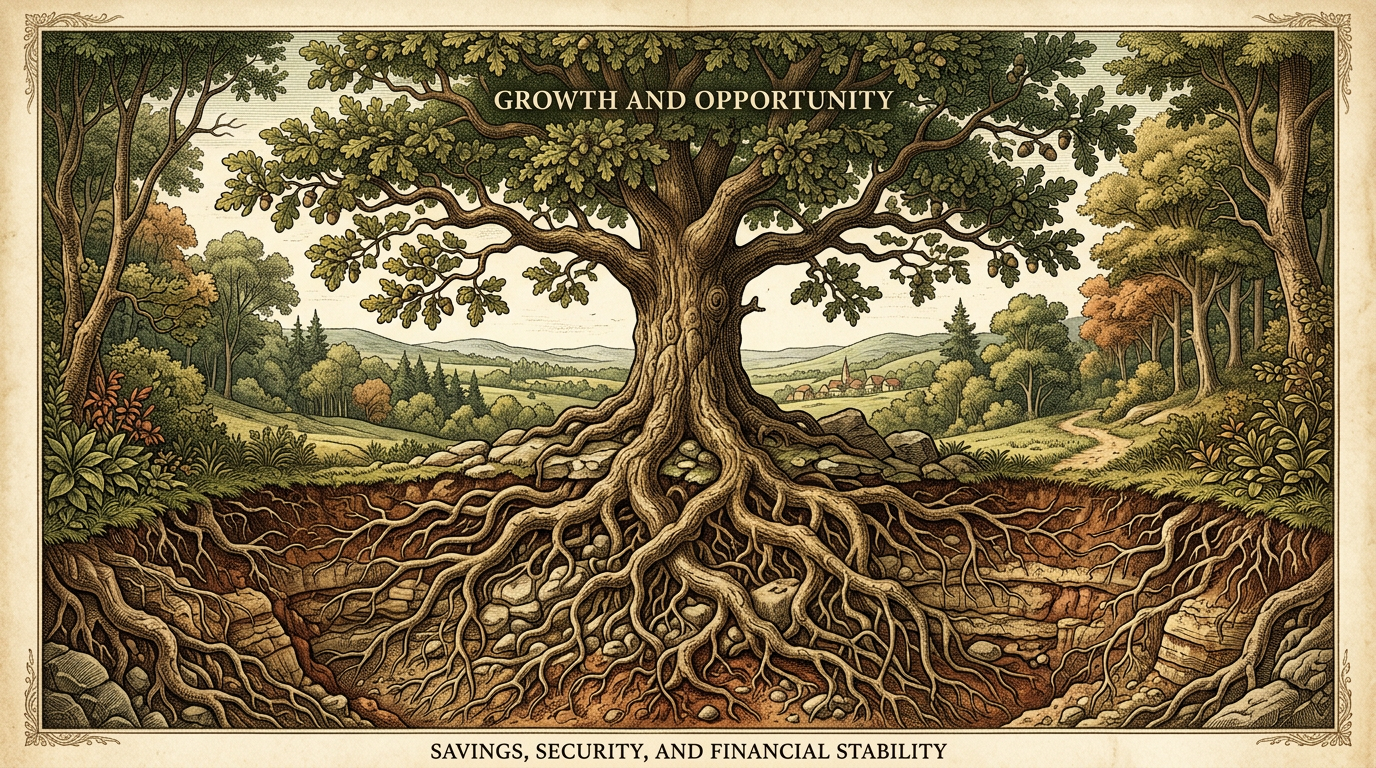
Think about a large tree.
Its branches stretch outward.
Its leaves capture sunlight.
Its canopy grows year after year.
That’s the part everyone notices.
But beneath the ground is an enormous system of roots.
The roots aren’t glamorous.
They aren’t the part people photograph.
Yet they help anchor the tree when the weather changes.
Your long-term investments are the branches.
Your financial margin is part of the root system.
Both matter.
And a strong financial life needs more than visible growth.
The goal isn’t just to build something impressive. It’s to build something that can withstand a storm.
🌱 The Daily Vine
TODAY’S THOUGHT
“Not every dollar needs to make you richer. Some dollars are there to keep you secure.”
📚 Book Recommendation
The Psychology of Money by Morgan Housel. A thoughtful exploration of financial behavior, risk, uncertainty, and the value of having room for error.
🎯 Today’s Challenge
Review your accessible savings. Ask yourself whether an unexpected expense or temporary loss of income would force you to disrupt your long-term financial plans.
💰 Money Minute
Consider setting up a separate savings account dedicated to unexpected expenses. An automatic transfer, even a small one, can help you build the habit.
❤️ Relationship Reminder
Financial planning is a shared conversation. Discuss with your spouse or partner what feeling financially secure means to each of you.
🙏 Gratitude Prompt
Remember a time when having money available helped you or your family through an unexpected situation. What did that experience teach you?
🌿 Grow Today
Give every dollar a purpose. Some money is for enjoying today, some for protecting tomorrow, and some for building your future.
The Compound Corner
Wealth habit: Automate your safety net
Choose an affordable amount to transfer into a dedicated emergency account each payday. Review it periodically as your circumstances change.
Investing lesson: Protect your investment horizon
Keeping appropriate near-term reserves may reduce the likelihood of having to sell long-term investments to cover an unexpected expense.
Financial term: Liquidity
Liquidity describes how easily an asset can be converted into spendable cash without significantly affecting its value. Cash in a savings account is generally more liquid than real estate.
Recommended Resources
- The Psychology of Money — Morgan Housel
- The Simple Path to Wealth — JL Collins
- The Millionaire Next Door — Thomas J. Stanley and William D. Danko
- A financial planning journal or budget planner
- CFPB’s free emergency savings guide
Affiliate disclosure: Some recommended resources may include affiliate links when published. SproutVine may earn a commission from qualifying purchases at no additional cost to readers. This article is educational and not individualized financial advice.
FAQ
What is financial margin? Financial margin is the breathing room created by having accessible savings and manageable financial obligations. It helps you absorb unexpected expenses without immediately disrupting other goals.
How much should I keep in emergency savings? A common starting guideline is three to six months of essential living expenses. Your appropriate reserve may be higher or lower depending on income stability, dependents, insurance, and other circumstances.
Should I invest my emergency fund? An emergency fund generally prioritizes safety and accessibility. Investments that can fluctuate significantly may be unsuitable for money needed at short notice.
Is keeping cash a waste of money? Cash can lose purchasing power through inflation and may earn less than long-term investments, but it provides liquidity and stability. Its usefulness depends on the purpose of the money.
Can I build emergency savings and invest simultaneously? Yes. Many people divide available money between accessible reserves and long-term investments, adjusting the balance as their circumstances change.