

There’s something about the silence after losing a pet that is almost impossible to explain.
The house looks the same.
The furniture hasn’t moved.
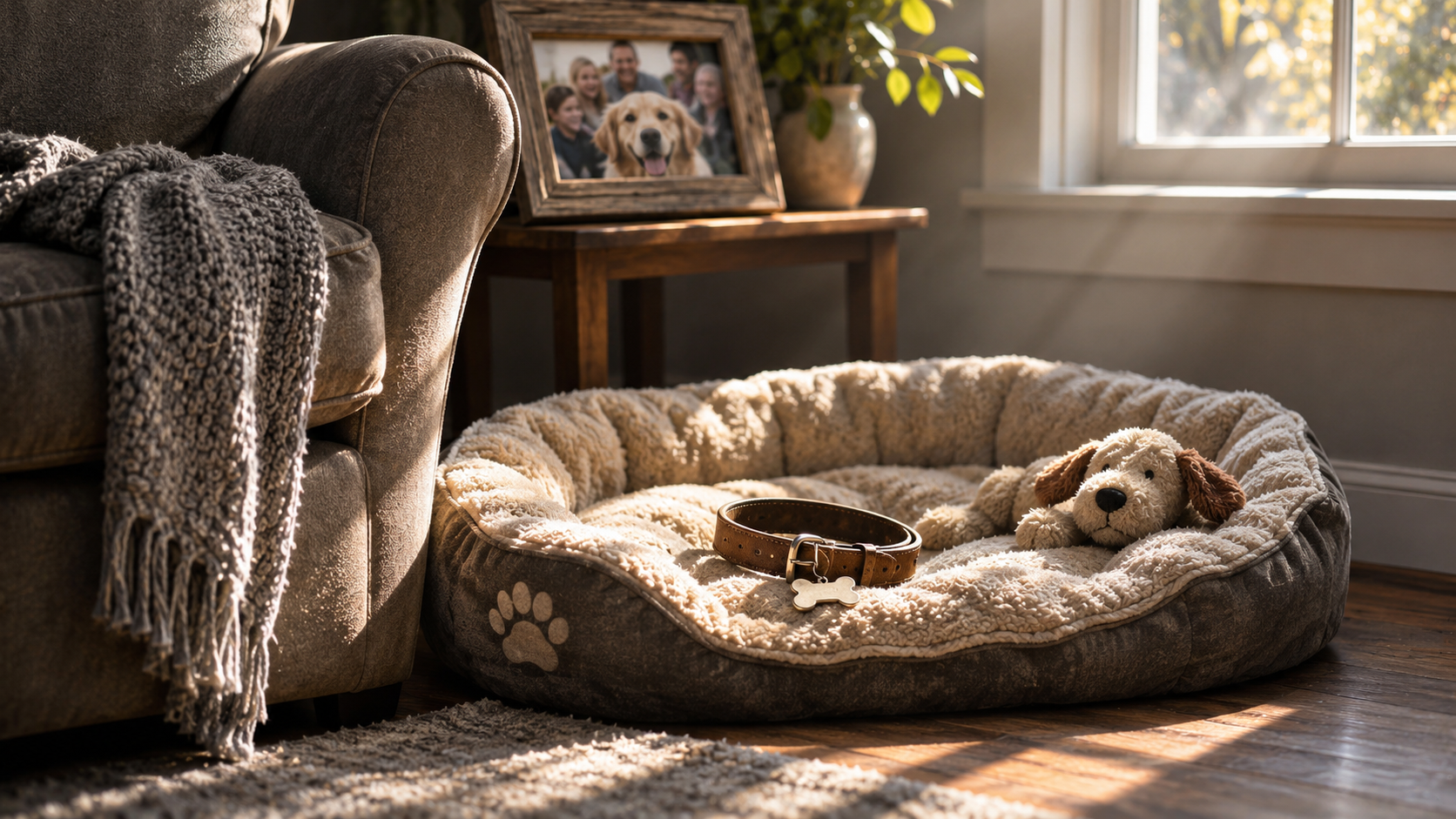
Their favorite spot is still there.
The food bowl may still be sitting in the kitchen. Their toys might still be scattered across the floor. Their bed is exactly where it was yesterday.
But something is missing.
You walk through the front door, and nobody comes running.
You wake up in the morning, and there’s no familiar sound of paws moving across the floor.
You sit down on the couch, and the little companion who always found a way to squeeze beside you isn’t there anymore.
You might even catch yourself calling their name.
And then, for one brief, heartbreaking second, you remember.
They’re gone.
To someone who has never loved an animal, this kind of grief might be difficult to understand.
They may say something well-intentioned like, “It was just a dog.”
Or, “You can always get another one.”
But anyone who has ever shared their life with a beloved pet knows something those words fail to recognize.
They were never just a pet.
They were family.
And losing them means saying goodbye to a member of your family who loved you in a way few others ever could.
The Family Member Who Never Needed an Invitation
Think about the day your pet first came home.
Maybe they were a tiny puppy with oversized paws and absolutely no understanding of house rules.
Maybe they were a kitten who immediately decided the entire house belonged to them.
Perhaps they were a rescue animal who needed patience, reassurance, and time before they finally felt safe.
Whatever the circumstances, something remarkable happened over the months and years that followed.
They became part of your life.
Not in some distant, occasional way.
They became part of everything.
They learned your routines.
They knew when it was time to eat.
They recognized the sound of your car pulling into the driveway.
They knew which family member was most likely to sneak them a treat.
They discovered the most comfortable spot on the couch, even if you repeatedly insisted they weren’t allowed up there.
They became experts at recognizing the difference between you putting on your shoes for work and putting on your shoes for a walk.
And somehow, without ever speaking a word, they found their way into the center of your family.
They were there for birthday parties.
Christmas mornings.
Family movie nights.
Lazy Sundays.
Ordinary Tuesdays.
They appeared in the background of family photographs, curled up beside the Christmas tree or sleeping under the kitchen table.
They weren’t guests in your home.
It was their home, too.
They Were There for the Chapters of Your Life
One of the most extraordinary things about loving a pet is how many different versions of us they get to know.
Maybe your dog was there when you moved into your first house.
Maybe they were there when you got married.
When your children were born.
When your kids learned to walk.
When your family grew.
When you changed jobs.
When life was wonderful.
And when life was incredibly difficult.
Pets have a way of becoming quiet witnesses to our lives.
They don’t understand mortgages, promotions, financial stress, or complicated relationships.
But they understand when we’re happy.
They notice when we’re upset.
They recognize when the household feels different.
And sometimes, when everything else in life feels uncertain, they offer something remarkably simple.
They stay close.
A dog resting its head on your knee.
A cat curling up beside you.
A familiar little presence following you from room to room.
They don’t ask you to explain what’s wrong.
They don’t expect you to have everything figured out.
They just want to be near you.
And over time, that uncomplicated companionship becomes one of the most comforting parts of everyday life.
The Love That Asked for So Little
There’s a reason people often describe the love of a pet as unconditional.
Our relationships with animals are different from our relationships with people.
They don’t care how much money we make.
They aren’t impressed by our job titles.
They don’t judge our appearance.
They don’t know whether we had a productive day.
They don’t care if the house is perfectly clean or if dinner came from a restaurant instead of the kitchen.
They’re simply happy we’re home.
Of course, pets have needs, personalities, and expectations of their own.
Some demand attention.
Some are stubborn.
Some have a remarkable talent for getting into trouble.
But their affection often feels refreshingly uncomplicated.
After a difficult day, a wagging tail can make the world feel a little less overwhelming.
A familiar purr can make a quiet room feel less lonely.
And the simple act of being greeted by an animal who is genuinely excited to see you can become something you look forward to every single day.
We don’t always realize how much those moments mean until they’re gone.
The Little Things You Miss the Most
When we imagine losing a pet, we tend to think about the big things.
The final goodbye.
The last trip to the veterinarian.
The difficult decision no pet owner ever wants to face.
But afterward, it’s often the smallest things that hurt the most.
The empty space beside your bed.
The leash hanging by the door.
The sound you expect to hear when someone opens a bag of treats.
The way you instinctively look toward their favorite sleeping spot.
The habit of checking the backyard before closing the door.
The little piece of food you almost set aside because you know they would have wanted it.
These ordinary moments can become painful reminders.
Not because they’re dramatic.
But because they were part of your life for so long.
You didn’t just love your pet during special occasions.
You loved them in the everyday routines that made your house feel like home.
And when those routines suddenly disappear, the absence can feel enormous.
Sometimes grief isn’t loud. Sometimes it’s a quiet room where there used to be the sound of little paws.
Why Losing a Pet Hurts So Much
Pet loss can bring genuine, profound grief.
For many people, an animal has been a constant companion for ten, fifteen, or even twenty years.
That’s a significant portion of a lifetime.
During those years, the relationship becomes woven into daily habits, family traditions, emotional support, and a sense of belonging.
When a pet dies, you’re not simply losing an animal you cared about.
You’re losing a relationship.
A companion.
A familiar presence.
A source of comfort.
And a living connection to important memories.
You may also be grieving the version of your family that existed while they were alive.
The children were younger.
The house was different.
Life had a different rhythm.
Your pet was there through all of it.
Their passing can make you suddenly aware of just how much time has gone by.
And that realization can bring a second layer of sadness.
Because you’re not only saying goodbye to them.
You’re also saying goodbye to a chapter of your own life.
The Painful Responsibility of Loving Them Until the End
Perhaps the most difficult part of pet ownership is knowing that, in many cases, we will outlive the animals we love.
We bring them into our homes knowing that our time together will probably be shorter than we want.
But when they’re young and healthy, the years seem endless.
We imagine they’ll always be there.
Then, gradually, things begin to change.
They move a little slower.
The walks become shorter.
The stairs become more difficult.
Their hearing isn’t quite what it used to be.
Their face begins turning gray.
They sleep more.
They need medications, special diets, or extra help getting comfortable.
And we find ourselves doing things we never imagined we’d have to do.
Carrying them outside.
Helping them stand.
Cleaning up accidents without complaint.
Rearranging our schedules around veterinary appointments.
Watching carefully for signs of pain.
Trying to determine whether they’re having more good days than difficult ones.
Eventually, some families face one of the hardest decisions imaginable: whether to pursue further treatment, continue comfort-focused care, or consider humane euthanasia.
There is no simple emotional answer to that decision.
Veterinary guidance, the animal’s comfort, prognosis, and quality of life all matter.
But for the people who love them, the decision can feel unbearable.
We want more time.
Another week.
Another month.
One more Christmas.
One more morning waking up together.
Yet sometimes love asks us to consider what is kindest for them, even when it breaks our hearts.
And that is an extraordinarily difficult responsibility.
The Guilt That Can Follow
After losing a pet, many people replay the final days.
Should we have noticed something sooner?
Should we have tried another treatment?
Did we wait too long?
Did we make the decision too early?
Were they scared?
Did they know how much we loved them?
These questions can be painful.
And sometimes they persist even when a family made thoughtful decisions with veterinary guidance.
Grief often searches for explanations.
It looks for moments we might have changed.
It imagines different outcomes.
But hindsight gives us information we didn’t necessarily have at the time.
And loving an animal doesn’t mean having the power to prevent every illness, injury, or consequence of aging.
If you’re struggling with guilt, it may help to remember the full life you shared rather than allowing the final days to define everything.
Remember the walks.
The treats.
The vacations.
The warm beds.
The silly habits.
The attention.
The countless ordinary days when they were safe, cared for, and surrounded by people who loved them.
Their life was much bigger than their final moments.
Helping Children Say Goodbye
For children, losing a family pet may be their first meaningful experience with death.
A dog who has been part of the family for twelve years may have been there for a child’s entire life.
That animal was there when they learned to crawl.
When they took their first steps.
When they started school.
When they came home after difficult days.
To a child, the family pet may feel as permanent as the house itself.
And suddenly, they’re gone.
Children process grief differently depending on their age, personality, and understanding of death.
Some cry immediately.
Others ask practical questions.
Some seem fine one moment and devastated the next.
Younger children may repeatedly ask when the pet is coming home.
Older children may withdraw or struggle with feelings they don’t know how to express.
Parents can help by being honest in age-appropriate language.
Explain what happened clearly and gently.
Avoid confusing phrases such as “went to sleep” when discussing death with very young children, because they may misunderstand what that means.
Let children ask questions.
Allow them to cry.
Share memories.
Look through photographs.
Consider creating a small memorial together.
And remember that children often learn how to respond to grief by watching the adults around them.
It’s okay for them to see that you’re sad, too.
They don’t need you to pretend the loss doesn’t hurt.
They need to know that loving someone deeply sometimes means grieving deeply.
When the House Feels Different
One of the hardest experiences after losing a pet is returning home.
Especially if you’ve spent years being greeted at the door.
You open it out of habit.
For a split second, you expect the familiar excitement.
The barking.
The tail wagging.
The little dance they always did.
But the house is quiet.
And that quiet can feel almost physical.
Their absence changes the atmosphere.
You might notice it most in the morning.
Or when everyone else has gone to bed.
Or when you’re sitting in the room where they always slept.
There’s no correct timeline for adjusting to that silence.
Some people put away their pet’s belongings immediately because seeing them is too painful.
Others leave everything exactly where it was for weeks or months.
Some create a memorial.
Others prefer private memories.
There’s no single right way to grieve.
The important thing is giving yourself permission to experience the loss without feeling that you need to justify it.
“It’s Just an Animal” Misses the Entire Point
One of the most hurtful things someone can say to a grieving pet owner is, “It was just an animal.”
Those words may come from someone who doesn’t understand the relationship.
But they can make a person feel embarrassed about their sadness.
As though the grief is excessive.
As though the love was somehow less legitimate because the family member had four legs instead of two.
But love isn’t measured by species.
It’s measured by connection.
By companionship.
By the memories you create.
By the place someone holds in your life.
A pet can provide years of comfort, laughter, loyalty, and affection.
They can become a child’s best friend.
An older adult’s constant companion.
A source of comfort during difficult seasons.
A daily reason to smile.
The grief that follows their death reflects the significance of that bond.
You don’t have to compare it with any other kind of loss.
You don’t have to prove that it deserves recognition.
If the relationship mattered, the grief matters.
The Memories That Eventually Make You Smile Again
At first, remembering your pet may feel almost unbearable.
Every photograph brings tears.
Every story reminds you of what you’ve lost.
Even happy memories can hurt.
But for many people, something gradually begins to change.
You start remembering the funny things.
The ridiculous sleeping positions.
The way they begged for food.
The toys they destroyed.
The strange noises they made.
The trouble they got into.
The time they stole an entire sandwich off the counter.
The way they always managed to find the one muddy puddle in the yard.
You remember their personality.
The things that made them uniquely themselves.
And eventually, some of those memories begin bringing more smiles than tears.
That doesn’t mean you miss them any less.
It means your grief is making room for gratitude.
The sadness may never disappear completely.
But the memories can become a source of comfort rather than only pain.
Should You Get Another Pet?
After losing a beloved animal, people often wonder whether they’ll ever be ready to welcome another pet.
Some families want to adopt again relatively soon.
The house feels too empty.
They miss the companionship.
They have love and care to offer another animal.
Others cannot imagine bringing home a new pet for months or years.
And some decide that they don’t want another.
All of those choices can be valid.
A new pet doesn’t replace the one you’ve lost.
They will have a different personality.
Different habits.
Different quirks.
Different ways of showing affection.
And that’s okay.
Love isn’t a limited resource.
Welcoming another animal doesn’t erase the bond you had with the one who passed away.
But you also don’t owe anyone a timeline for when, or whether, you’re ready.
The right decision is the one that fits your family, circumstances, and emotional readiness.
The Last Great Lesson They Teach Us
Pets teach us remarkable things throughout their lives.
They teach us patience.
Responsibility.
Compassion.
Consistency.
How to care for someone who depends on us.
How to appreciate simple pleasures.
How to enjoy a walk without worrying about tomorrow.
How to be excited about seeing someone we love, even if they’ve only been gone for twenty minutes.
But perhaps their final lesson is the hardest.
They teach us that loving deeply means accepting the possibility of loss.
We cannot keep them forever.
No matter how much we wish we could.
We cannot stop time.
We cannot prevent every illness.
We cannot make their lives as long as ours.
But we can make the time we share meaningful.
We can give them a safe home.
Good food.
Comfort.
Medical care.
Attention.
Affection.
And a family that considers them one of its own.
In return, they give us something that often feels immeasurable.
Years of companionship.
Countless memories.
And a kind of love that stays with us long after they’re gone.
If You Could Have One More Day
If you’ve lost a pet, you’ve probably imagined having one more day.
One more walk.
One more afternoon on the couch.
One more chance to scratch behind their ears.
One more opportunity to tell them how much they meant to you.
But perhaps there’s something comforting in remembering that you didn’t need one perfect final day to show them your love.
You showed them throughout their life.
Every time you filled their bowl.
Every time you opened the door.
Every time you took them to the veterinarian.
Every time you made room for them beside you.
Every time you laughed at their ridiculous behavior.
Every time you cared for them when they weren’t feeling well.
Every time you came home.
Love wasn’t something you saved for the end.
It was present in thousands of ordinary moments.
And those moments mattered.
They Were Part of Your Family
Eventually, the food bowl may be put away.
The bed may be moved.
The toys may be packed into a box.
The familiar routines will change.
Life will continue.
The family will make new memories.
The children will grow older.
Years may pass.
But every now and then, something will remind you of them.
A photograph.
A familiar sound.
A dog that looks just like yours.
A memory from a family vacation.
A story someone brings up at dinner.
And for a moment, they’ll be right there again.
Not physically.
But in the memories that still belong to your family.
Because that’s what they were.
Family.
They weren’t simply an animal who happened to live in your house.
They were part of your daily life.
Part of your routines.
Part of your happiest memories.
Part of your children’s childhoods.
Part of your story.
And when they passed away, they left an empty space that no other pet could fill in exactly the same way.
But they also left something beautiful.
The knowledge that your family had the privilege of loving them.
And that they spent their life being loved in return.
They may have only been part of your life for a chapter.
But you were their whole world.
And what a beautiful thing it is to have been someone’s whole world.
🌱 The Daily Vine
💭 1. Today’s Thought
“They were never just a pet. They were part of the family, part of our memories, and part of the love that made our house a home.”
📚 2. Book Recommendation
The Loss of a Pet — Wallace Sife
A compassionate resource for understanding and processing the grief that can follow the death of a beloved animal companion.
🎯 3. Today’s Challenge
If you have a pet, spend a few extra minutes with them today.
Take the longer walk.
Give them the extra attention.
Put down your phone and enjoy their company.
Those ordinary moments are worth appreciating.
💰 4. Money Minute
Pet ownership comes with financial responsibilities, including veterinary care, preventive treatments, food, and potential emergencies.
Consider maintaining a dedicated pet-care savings fund or evaluating whether pet insurance fits your circumstances.
Financial preparation can make difficult medical decisions a little less stressful.
❤️ 5. Relationship Reminder
When someone loses a pet, don’t minimize their grief.
You don’t need to find the perfect words.
Sometimes simply saying, “I know how much they meant to you, and I’m so sorry,” is enough.
🙏 6. Gratitude Prompt
Think about an animal that brought happiness into your life.
What’s one memory that still makes you smile?
Take a moment to appreciate the love you shared.
🌿 7. Grow Today
Give yourself and others permission to grieve without comparison.
Love comes in many forms.
And losing a beloved animal companion can be a profound experience.
❤️ Today’s Reflection Question
If your pet could understand one final thing you wanted to tell them, what would you want them to know?
And if you’re fortunate enough to still have them beside you, how can you show them that love today?
📚 Recommended Resources
- The Loss of a Pet — Wallace Sife https://link.amazon/B03pm8rEM
- Goodbye, Friend: Healing Wisdom for Anyone Who Has Ever Lost a Pet — Gary Kowalski https://link.amazon/B02RdMocg
- When a Pet Dies — Fred Rogers https://link.amazon/B00n03lGU
- The Forever Dog Life — Rodney Habib and Dr. Karen Shaw Becker (general pet wellness, not a grief resource) https://link.amazon/B00oytcXx
Affiliate disclosure: Some recommended resources may contain affiliate links when published. SproutVine may earn a commission from qualifying purchases at no additional cost to readers.
Grief support note: If the loss of a pet is significantly affecting your daily functioning or feels overwhelming, consider reaching out to a grief counselor, mental health professional, or pet-loss support group.
❓ Frequently Asked Questions (FAQ)
1. Why does losing a pet hurt so much?
Losing a pet can be deeply painful because animals often become important members of our families. They provide companionship, affection, emotional comfort, and daily routines. Their death represents the loss of a meaningful relationship, which can trigger genuine grief.
2. Is it normal to grieve a pet like a family member?
Yes. Many people experience intense grief after losing a beloved pet. The depth of grief often reflects the emotional bond, shared experiences, and role the animal played in everyday life. There is no requirement to minimize your sadness simply because your loved one was an animal.
3. How long does grief last after losing a dog or cat?
There is no universal timeline for pet-loss grief. Some people begin adjusting within weeks, while others experience sadness for months or longer. Grief may also return around anniversaries, holidays, or familiar routines. The experience varies depending on the person and the relationship.
4. How can I help my child cope with losing a family pet?
Use clear, age-appropriate language to explain what happened. Encourage children to express their feelings, answer questions honestly, and allow them to participate in memorial activities if they wish. Sharing happy memories and acknowledging your own sadness can also help children understand that grief is a normal response to loss.
5. How do I cope with guilt after euthanizing my pet?
Guilt is a common response after making end-of-life decisions for an animal. It may help to remember the veterinary information available at the time, the animal’s quality of life, and the care you provided throughout their life. Speaking with a veterinarian, grief counselor, or pet-loss support group may also provide reassurance and perspective.
6. Should I keep my pet’s belongings after they pass away?
There is no right or wrong answer. Some people find comfort in keeping collars, toys, photographs, or beds as memorial items. Others prefer to put belongings away temporarily. Choose what feels supportive for you and your family, and remember that you can change your mind later.
7. When is the right time to get another pet after losing one?
The right time varies for every person and family. Some people feel ready relatively quickly, while others need months or years. A new pet cannot replace the one who died, but it can create a new and meaningful relationship when you’re emotionally and practically ready.
8. What should I say to someone who has lost a pet?
Offer simple, compassionate support. You might say, “I’m so sorry. I know how much they meant to you.” Avoid minimizing the loss or immediately suggesting a replacement pet. Listening, sharing a positive memory, or acknowledging the animal by name can be especially meaningful.
🌱 Today’s SproutVine Takeaway
The hardest part of loving a pet is knowing we can never keep them long enough. But the beautiful part is knowing that, for the years they were here, they had a family, a home, and a lifetime of love.